Research
Nuclear-Electronic Orbital Method


Our NEO code is available in
Periodic NEO methods are available in FHI-aims: https://fhi-aims.org/

NEO-HF (Hartree-Fock)
NEO-MP2 (second-order perturbation theory)
NEO-OOMP2, NEO-SOS-OOMP2 (orbital-optimized MP2)
NEO-CC (coupled-cluster with singles, doubles, triples, and perturbative triples)
NEO-UCC (unitary coupled cluster)
NEO-EOM-CCSD (equation-of-motion coupled-cluster singles and doubles)
NEO-NOCI (nonorthogonal CI)
NEO-CASSCF/MRCI (complete active space self-consistent-field/multireference configuration interaction)
NEO-TDCI (time-dependent configuration interaction)
NEO-DFT
Electron-proton correlation functionals (epc17, epc18, epc19)
NEO-TDDFT (linear-response time-dependent DFT)
RT-NEO-TDDFT (real-time NEO-TDDFT)
NEO-MSDFT (multistate DFT)
Periodic NEO-DFT, RT-NEO-TDDFT, Ehrenfest dynamics
Adiabatic dynamics on NEO-DFT, TDDFT, MSDFT vibronic surfaces
Ehrenfest and surface hopping dynamics on NEO-DFT and MSDFT vibronic surfaces
RT-NEO-TDDFT with Ehrenfest dynamics
NEO-TDCI
Analytical gradients for NEO-HF, NEO-DFT, NEO-TDDFT, NEO-MSDFT
Analytical Hessians for NEO-HF, NEO-DFT, NEO-MSDFT
Geometry optimizations, transition states, minimum energy paths, thermochemistry
Development of protonic basis sets
Development of electronic basis sets for quantized hydrogens
Density fitting
Simultaneous optimization methods and Hartree product for nuclei
Full molecular vibrational frequencies (NEO-DFT(V) or cNEO-DFT Hessian)
NEO-PCM (polarizable continuum model)
NEO-QM/MM (quantum mechanical/molecular mechanical)
Stability conditions for NEO-HF and NEO-DFT
Diagonal Born-Oppenheimer corrections for NEO-HF and NEO-DFT
NEO-FMO (fragment molecular orbital)
NEO vibronic coupling theory for H tunneling splittings
NEO explicitly correlated methods with Gaussian-type geminal functions (XCHF and RXHF, not computationally practical in current form)
Polaritonic chemistry: We are using RT-NEO-TDDFT and NEO-TDCI to investigate polaritonic chemistry, such as photoinduced proton transfer in a cavity.
Plasmonic chemistry: We are using RT-NEO-TDDFT to study plasmonic chemistry, such as plasmon-induced H2 dissociation from a metal cluster.
Magnetic fields: We are using RT-NEO-TDHF to study the effects of an external magnetic field on proton motion.
pKa and kinetic isotope effect calculations: We are using NEO-DFT and NEO-MSDFT to compute relative pKa values and kinetic isotope effects of molecular systems.
Vibrational spectra: We are using RT-NEO-TDDFT to compute vibrational spectra, including the anharmonic effects of the hydrogen motions.
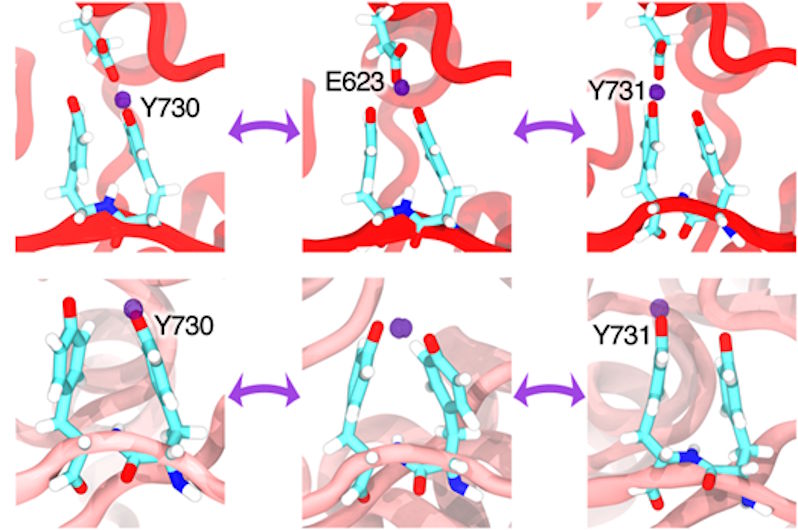
QM/MM simulations of proteins: We are using NEO-QM/MM methods to calculate the free energies of proton, hydride, and proton-coupled electron transfer in enzymes.


Princeton University, Department of Chemistry open_in_new
Frick Chemistry Laboratory, 353
open_in_new
Princeton, NJ 08544
Direct dynamics with nuclear-electronic orbital density functional theory
316. Z. Tao, Q. Yu, S. Roy, and S. Hammes-Schiffer, “Direct dynamics with nuclear-electronic orbital density functional theory,” Acc. Chem. Res. 54, 4131-4141 (2021). DOI: 10.1021/acs.accounts.1c00516
Nuclear-electronic orbital methods: Foundations and prospects
306. S. Hammes-Schiffer, “Nuclear-electronic orbital methods: Foundations and prospects,” J. Chem. Phys. 155, 030901 (2021). DOI: 10.1063/5.0053576
Multicomponent quantum chemistry: Integrating electronic and nuclear quantum effects via the nuclear-electronic orbital method
273. F.Pavošević, T. Culpitt, and S. Hammes-Schiffer, “Multicomponent quantum chemistry: Integrating electronic and nuclear quantum effects via the nuclear-electronic orbital method,” Chem. Rev. 120, 4222-4253 (2020). DOI: 10.1021/acs.chemrev.9b00798