Research
Biological Processes


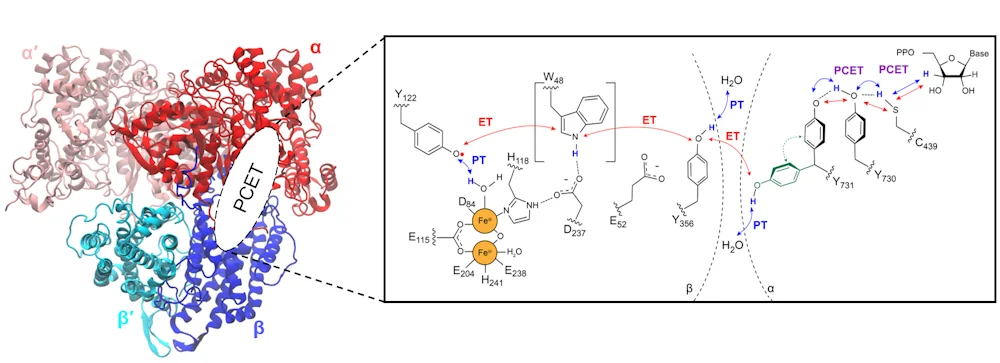
Ribonucleotide reductase: We are investigating PCET in ribonucleotide reductase, which is essential for DNA synthesis in all living organisms. Our focus is on long-range radical translocation over ~32 Å to generate a cysteine radical that initiates catalysis. This radical translocation occurs via six PCET reactions involving tyrosine and tryptophan residues spanning two different protein subunits. We are utilizing a combination of approaches, including classical molecular dynamics, quantum mechanical/molecular mechanical free energy simulations, nonadiabatic PCET theory, and microkinetic modeling. Our calculations have elucidated the roles of water and conformational motions, as well as the mechanisms of individual PCET reactions.
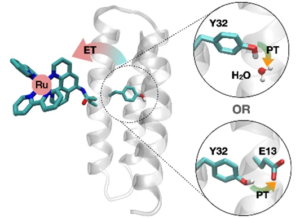
de Novo Proteins: We are studying PCET in de novo proteins to explore the fundamental principles of biological PCET in a structurally well-defined protein environment without the complexities associated with substrate and cofactor binding and large conformational changes. An illustrative example is α3X, which consists of three alpha helices with a single interior redox-active residue such as tyrosine or tryptophan that can be oxidized electrochemically or photochemically. This work is in collaboration with the experimental groups of Cecilia Tommos and Leif Hammarström.
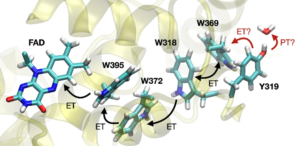
Cryptochromes: We are investigating cryptochromes, which are critical for circadian rhythms in both animals and plants, as well as plant growth and possibly magnetoreception for bird navigation. In Cry4 from the European robin, absorption of blue light by bound flavin adenine dinucleotide leads to a series of electron transfer reactions along a cluster of four tryptophan residues and possibly a tyrosine residue, generating a radical pair thought to play a role in magnetoreception. Our calculations are elucidating the mechanism of radical pair formation and dynamics.


Princeton University, Department of Chemistry open_in_new
Frick Chemistry Laboratory, 353
open_in_new
Princeton, NJ 08544