Biological Processes
The overall objective of these projects is to illuminate the role of hydrogen bonding, hydrogen tunneling, electrostatics, and conformational motions, as well as the impact of distal mutations, in enzyme reactions. Movies of hydrogen tunneling in DHFR are available below.
We have written several reviews on enzyme motion and catalysis.55, 58, 79, 81, 101, 131, 149, 171, 190
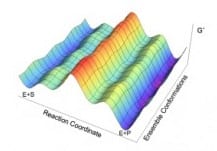
Our simulations suggested the concept of a free energy landscape for enzyme catalysis and the significant role of equilibrium, thermal conformational motions that lead to sampling of configurations conducive to chemistry.
We have performed classical molecular dynamics and quantum mechanical/molecular mechanical free energy simulations for various ribozymes,129, 137, 141, 150, 162, 170, 173, 188, 191, 214, 222 DNA,277 and enzymes.235, 237, 271, 279, 301 These simulations have provided mechanistic insights into these biologically important systems.
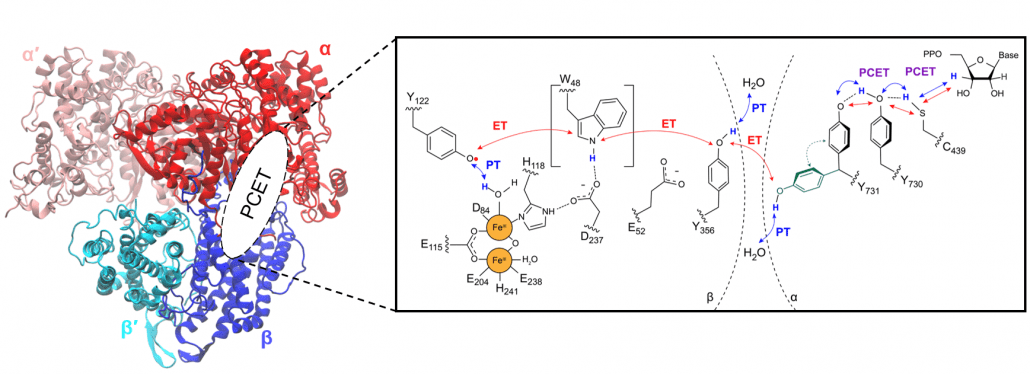
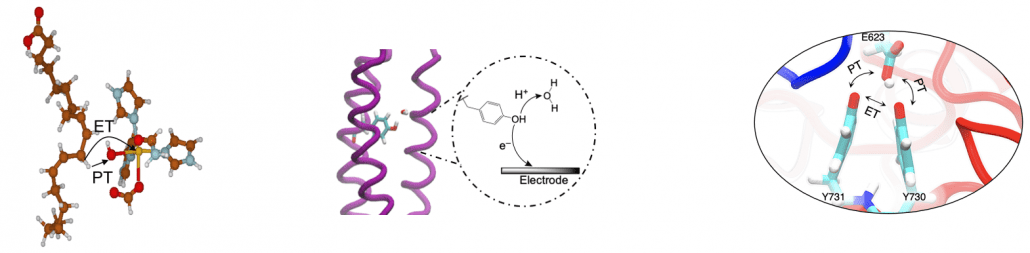
We have developed a theoretical formulation for proton-coupled electron transfer (PCET) reactions in enzymes. This theory includes the quantum mechanical effects of the active electrons and the transferring proton, as well as the motions of all atoms in the complete solvated enzyme system. We have derived a series of nonadiabatic rate constant expressions that are valid in well-defined regimes. In this theory, the rate constant and kinetic isotope effect (KIE) are strongly influenced by the equilibrium proton donor-acceptor distance and frequency, the vibronic coupling, the reaction free energy, and the protein/solvent reorganization energy. We have applied this theory to PCET in soybean lipoxygenase.64, 93, 126, 182, 213, 216, 219, 226 We are also studying PCET in the α3X protein, where X is tyrosine, tryptophan, or a non-canonical analog,278, 295 and ribonucleotide reductase.301
We have developed a hybrid quantum/classical molecular dynamics approach for simulating proton and hydride transfer reactions in enzymes.41, 46, 48 This hybrid approach includes electronic and nuclear quantum effects, as well as the motion of the entire solvated enzyme. The methodology provides detailed mechanistic information at the molecular level and allows the calculation of rate constants and kinetic isotope effects. It also enables us to investigate the relation between enzyme motion and activity. We have also developed computational methodology for calculating the vibrational shifts of nitrile probes (i.e., the vibrational Stark effect) upon ligand binding and along catalytic cycles in enzymes to investigate the role of electrostatics in enzyme catalysis.159, 179, 190
We have applied this hybrid approach to hydride transfer in liver alcohol dehydrogenase (LADH),34, 37, 41, 48 dihydrofolate reductase (DHFR),50, 51, 56, 63, 67, 71, 80, 83, 84, 113, 165, 179, 185 and ketosteroid isomerase (KSI)121, 127, 143, 159 These simulations have illuminated the roles of hydrogen bonding, hydrogen tunneling, electrostatics, and conformational motions, as well as the impact of distal mutations.